

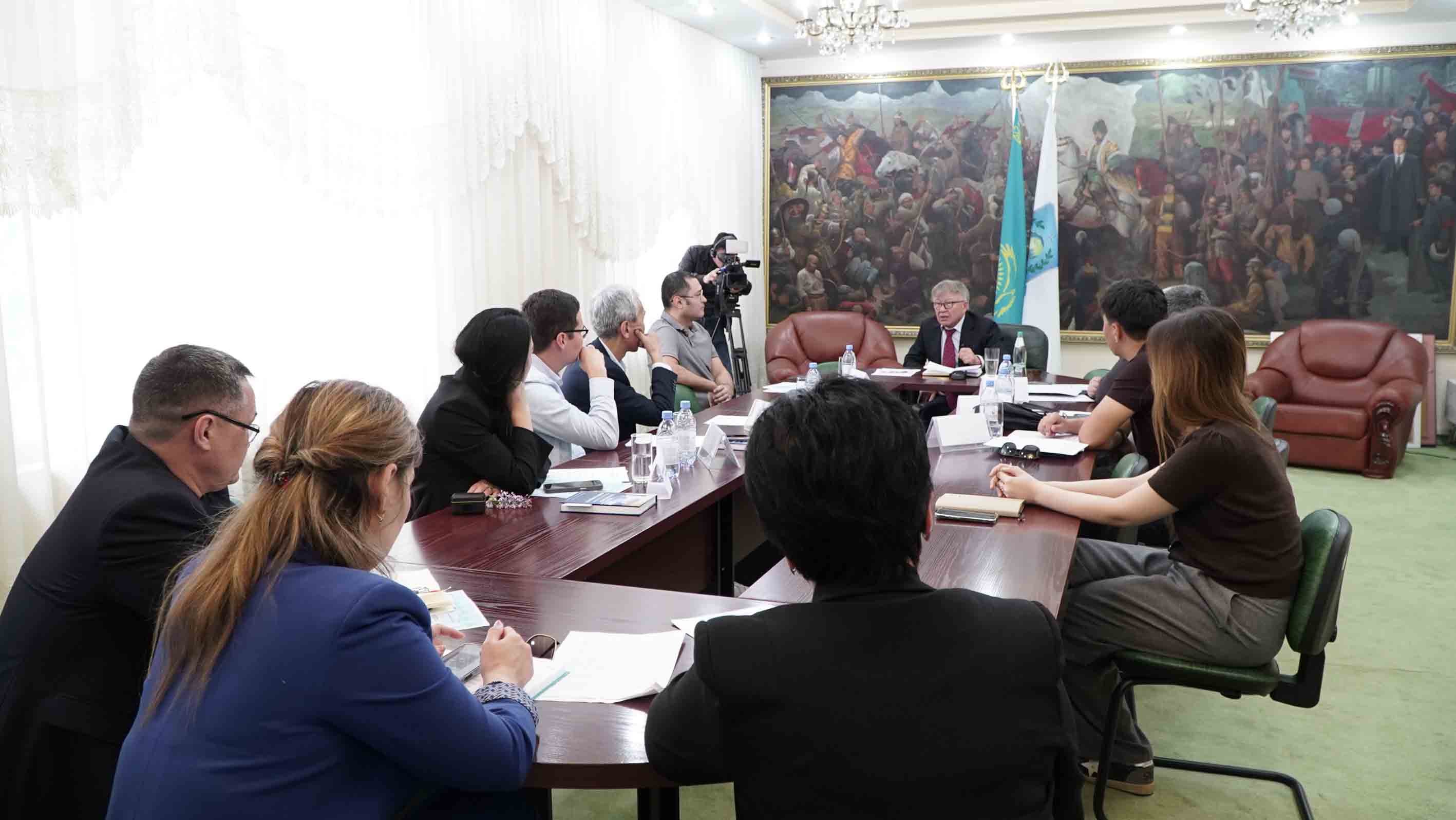
A press conference dedicated to the development of sports science in Kazakhstan and the implementation of innovative approaches to its modernization was held within the walls of the Kazakh Academy of Sport and Tourism. The event was moderated by the university’s president, Kairat Zakiryanov, who addressed key aspects of integrating science into athlete training and shared plans for creating projects aimed at identifying talents and helping them achieve success at the highest level.
According to data presented by Kairat Zakiryanov, the share of science in Kazakhstan’s GDP currently stands at only 0.13 percent. For comparison, in developed countries, this figure reaches 2–3 percent. Thus, in terms of scientific development, Kazakhstan lags behind Europe by a factor of 20 to 30.
The structure of scientific research also raises serious concerns: 82 percent of Kazakh developments fall under fundamental sciences, and only 18 percent are related to experimental design and applied research. Out of 3,000 scientific projects that have undergone expert review, only 29 are truly applied in nature and can be put into practice.
“At the Winter Olympic Games in Milan, Mikhail Shaydorov won a historic gold medal, opening a new chapter in the history of Kazakhstani winter sports. This is undoubtedly a source of pride. However, the 32-year gap between such achievements indicates systemic shortcomings in the sector,” noted the president of the Academy.
According to K. Zakiryanov, this raises logical questions: What are we missing? Where are the gaps? What scientifically based solutions are needed?
He recalled that back in 1967, by a decree of the USSR Council of Ministers, a unique scientific laboratory, “High Altitude and Sport,” was established in Almaty. It was precisely thanks to the scientific approach to training in mid-altitude conditions that Soviet and Kazakhstani athletes achieved outstanding results.
Today, the Academy has revived this tradition. Using its own funds, modern research facilities and sports infrastructure have been created in mid-altitude conditions. However, according to K. Zakiryanov, most of the Academy’s scientific developments (including 12 practice-oriented projects presented over the last five years) remain unnoticed and unsupported by the state.
He also spoke about several initiatives, including the creation of a new organization for the development of sports talent, whose main task will be to search for unique athletes across the country. These initiatives are expected to be led by legendary Kazakh Olympians: Vladimir Smirnov, Nelly Kim, Aliya Yussupova, Dmitriy Balandin, and other champions.
“No talented child should be left unnoticed. Our task, with the help of science, is to find talents and help them realize their potential at the highest level,” emphasized Kairat Zakiryanov.
The press conference served as an important platform for open discussion on how to make Kazakhstani sport competitive on the world stage and “transform” scientific developments into real medals. At the conclusion of his speech, the speaker noted that the Kazakh Academy of Sport and Tourism hopes that an open and honest conversation about the problems and pathways for the development of science will be a significant step toward real change in the sports industry.
Prepared by Ravil KASYMOV
Comments powered by CComment