

The mid-1990s were an era of fundamental state transformation for Kazakhstan. On August 30, 1995, a new Constitution was adopted by republican referendum, enshrining the principle of separation of powers and proclaiming the judicial branch as an independent branch of state power alongside the legislative and executive branches. This was a conceptually new position for the post-Soviet space.
A TIME OF FORMATION
On December 20, 1995, the President issued a decree having the force of law "On Courts and the Status of Judges in the Republic of Kazakhstan" – a document that laid the legal foundations for a unified judicial system and the principles of irremovability and independence of judges.
During the same period, the need arose to create a professional community of judges capable of consolidating the judiciary, protecting their rights, and enabling their participation in further reforms. This was precisely the mission accomplished by the First Congress of Judges.
ALMATY, DECEMBER 19, 1996
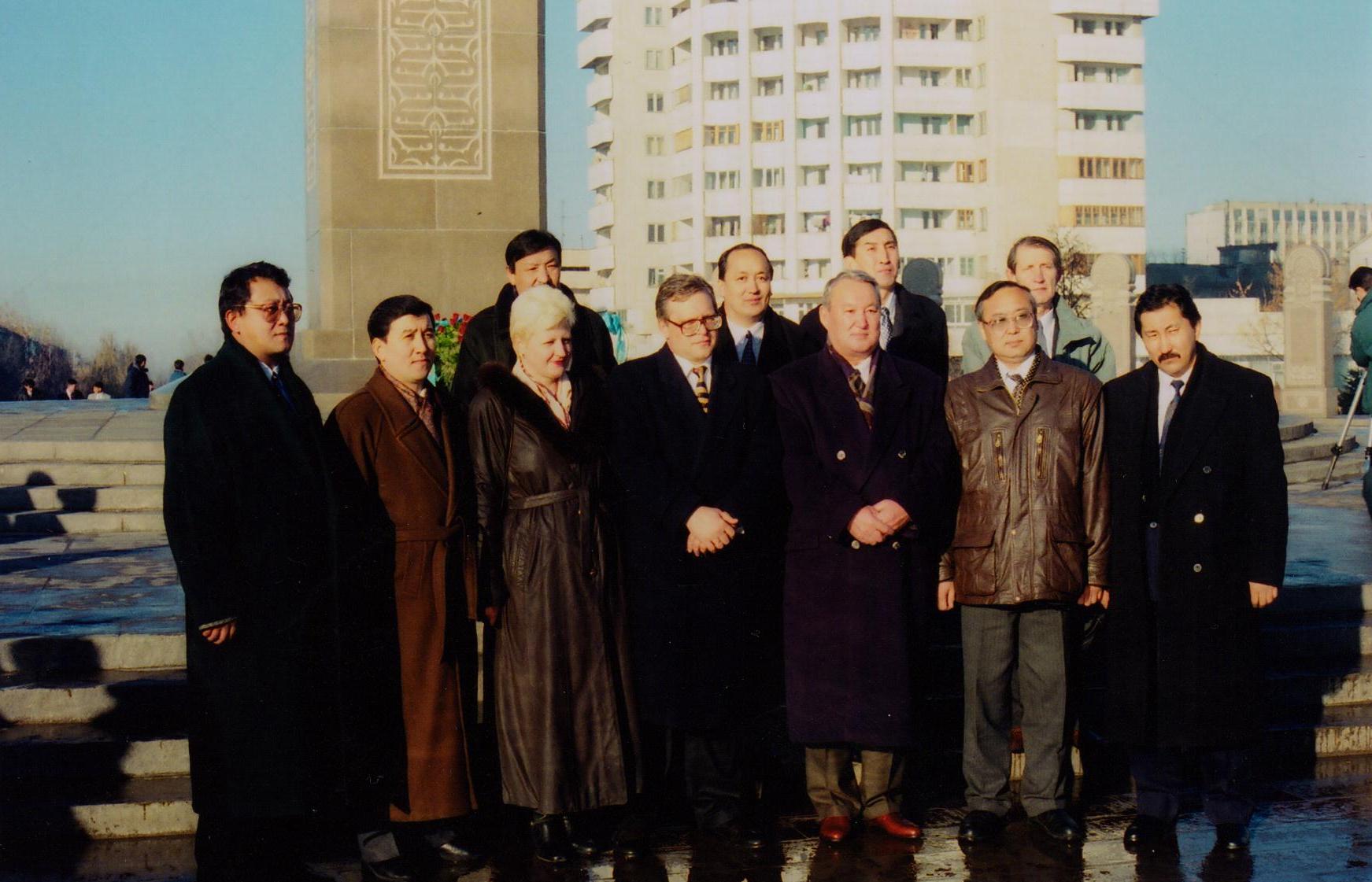
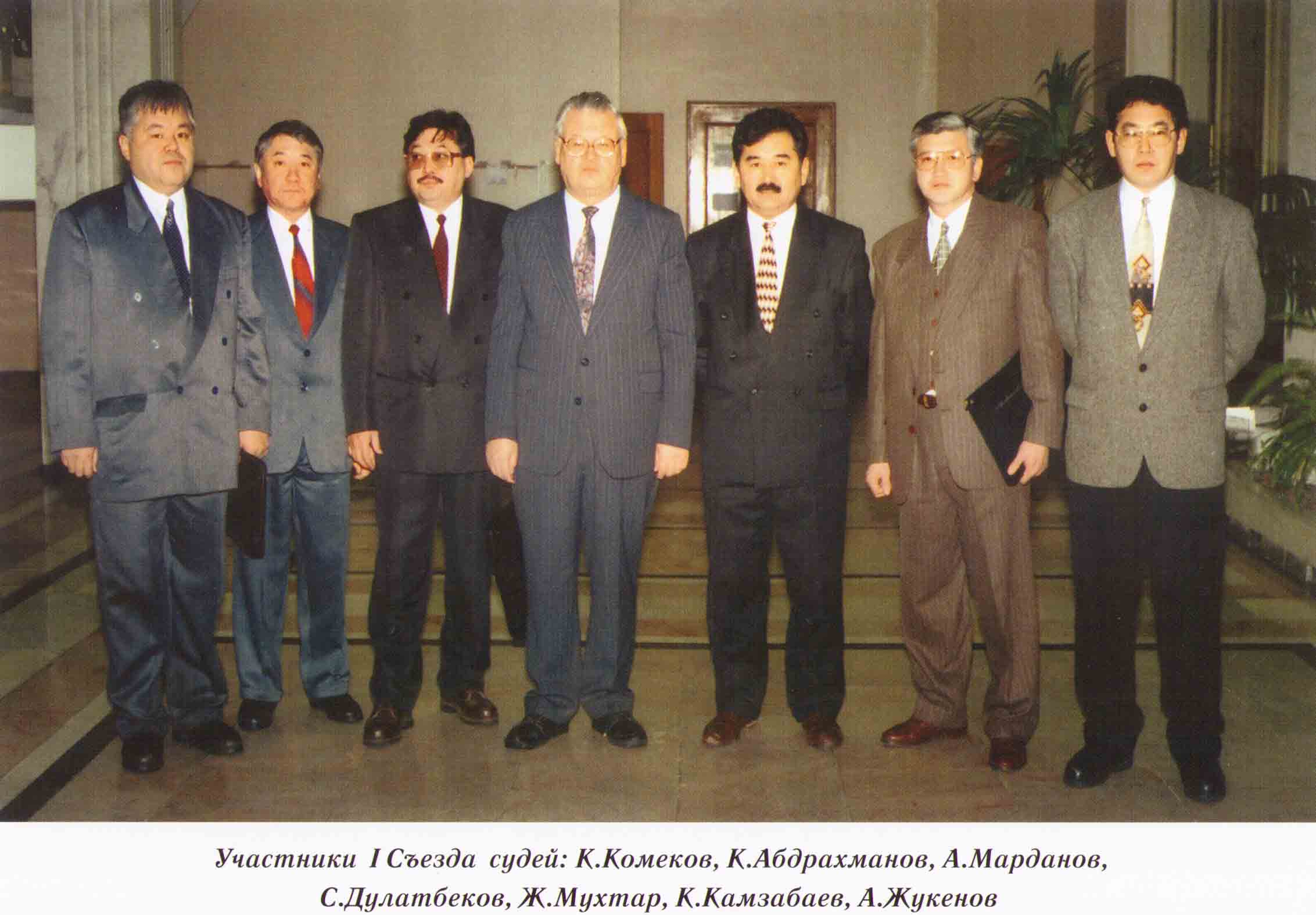
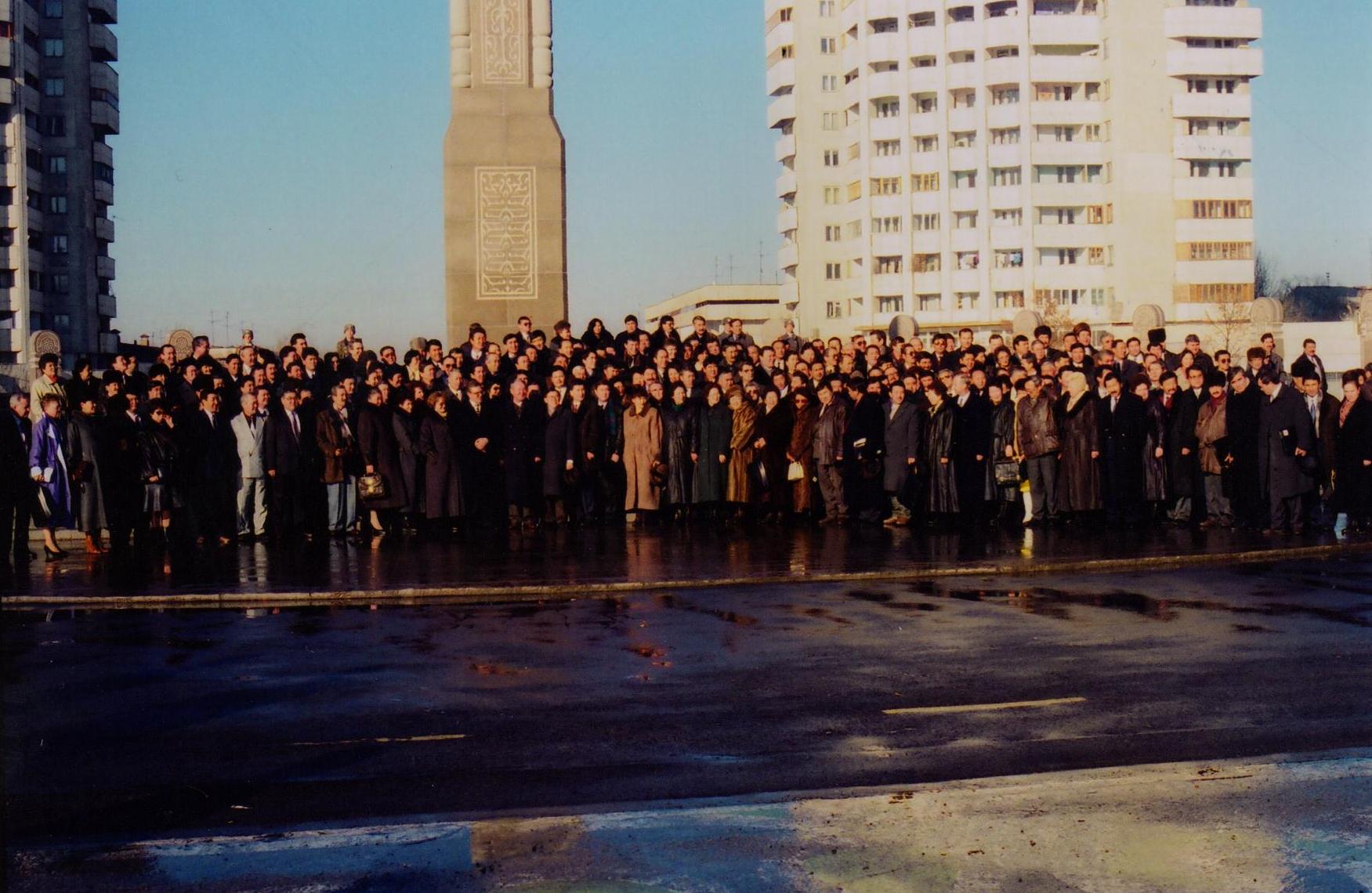
The First Congress of Judges of the Republic of Kazakhstan began its work on December 19, 1996, in the city of Almaty. This event brought together broad representation from the judiciary across all regions of the country. The forum was attended not only by judges but also by representatives of the country's top leadership, underscoring the event's special status.
Reports were delivered by M. Narikbayev, Chairman of the Supreme Court of the Republic of Kazakhstan, and K. Kolpakov, Minister of Justice.

The main historical outcome of the congress was the delegates' unanimous decision to establish the Republican Public Association "Union of Judges of the Republic of Kazakhstan." The congress adopted the organization's charter, defining it as a non-profit, non-political structure tasked with protecting judges' interests while strictly refraining from interfering in the administration of justice.
Alongside organizational matters, the Code of Judicial Ethics was also adopted. Thus, from the very outset, the judicial community declared that judicial independence is not a privilege but, above all, a great responsibility to society and a duty to adhere to ethical standards.
PRESSING PROBLEMS: A DIAGNOSIS OF THE SYSTEM
The congress was not merely a constituent assembly but also a frank discussion about the paths to establishing justice, the problems, and the real state of affairs in the judicial system.
This was evident in the speeches delivered at the congress by: N. Sharipov, judge of the Medeu District Court of Almaty; K. Kamzabayev, chairman of the Lenin District Court of Karaganda; K. Adranov, judge of the Terenozek District Court of Kyzylorda Region; I. Begin, judge of the Kokshetau Regional Court; I. Amirov, judge of the Aktobe Regional Court; A. Kobtsev, chairman of the Kostanay Regional Court; K. Tashenova, judge of the Shymkent City Court; S. Shutkin, Prosecutor General of the Republic of Kazakhstan; Y. Sadykov, chairman of the Oktyabr District Court of Ust-Kamenogorsk; T. Kireyeva, chairman of the East Kazakhstan Regional Court; T. Nabiyev, chairman of the Tekeli City Court of Taldykorgan Region; Z. Kaziyev, head of the Criminal Law Department at the Institute of the National Security Committee of the Republic of Kazakhstan; and L. Kapustina, judge of the North Kazakhstan Regional Court.
In his report, Supreme Court Chairman M. Narikbayev provided a thorough analysis of the work and voiced serious criticisms against a number of regional courts: "Over the nine months of this year, more than three thousand (3,126) criminal sentences and over one thousand five hundred (1,534) civil decisions of district courts have been overturned or modified. The quality of case consideration by district courts in Akmola, Aktobe, Atyrau, Mangistau, and North Kazakhstan regions remains low, with their error rate significantly exceeding the national averages.
The performance of regional courts, which should ostensibly set an example for the district level, continues to deserve the harshest assessment. Overall, every sixth verdict of regional courts is subject to review – every fourth verdict of the Almaty Regional Court, and every third verdict of the Mangistau and North Kazakhstan Regional Courts," noted Maksut Sultanovich in his report, citing other specific examples as well. This meticulous and rigorous analysis set the tone for an honest and open discussion about shortcomings and ways to address them.
The Supreme Court Chairman also noted: "Furthermore, some judges have yet to break the habit of playing it safe. As a result, there are numerous cases of unjust conviction or imposition of excessively harsh penalties. In the first half of this year, 89 people were found to have been unjustly convicted, including 25 in Aktobe Region, 7 in Karaganda Region, 5 in Semipalatinsk Region, and 17 in Almaty.
Often, the cause of such lawlessness is that investigative bodies and courts, focusing solely on solving crimes and punishing the guilty, do not always fairly assess the conduct of the victim, who is often subjected to pressure and threats of violence. Such inattention is simply unacceptable.
At the same time, courts must not allow the guilty to escape punishment through unjustified acquittals. Unfortunately, there are many such instances in judicial practice. Last year, 79 cases were overturned on cassation as illegal acquittals, and in the first half of this year, 35 accused persons were affected."
Delegates to the congress raised pressing issues regarding the administration of justice in the state language, including due to the absence of relevant legislative and other regulatory acts in the state language. Another serious aspect mentioned was the provision of courthouses, with the example given that most district courthouses in Almaty were in deplorable condition.
These and other issues formed the basis of the resolution adopted by the First Congress of Judges of the Republic of Kazakhstan – a document that is now a valuable historical record outlining several areas requiring further work.
In particular, the document noted that "many issues set out in the State Program for Legal Reform remain purely declaratory. Judicial proceedings have not been reorganized, with the result that the proclaimed principles of genuine adversarial proceedings and party equality have not been implemented, all elements of the court's prosecutorial role have not been eliminated, and the institution of appeal has not been introduced.
The current procedural order for hearing court cases does not allow for the full use of new substantive law, particularly civil law norms, which negatively affects the effectiveness of protecting the rights and legitimate interests of citizens and legal entities.
Legislative acts to establish the institution of court bailiffs and to raise the status of judicial executors have still not been adopted, which adversely affects the enforcement of court decisions, the security of courts, judicial personnel, and participants in proceedings.
The expansion of judicial competence, the increase in criminal and civil cases and administrative materials coming before the courts, and the insufficient number of judges have resulted in courts being unable to process incoming cases in a timely manner.
At the same time, judges' salaries do not correspond to their high status and do not ensure a decent standard of living, while the remuneration of court staff is entirely too low.
There are serious problems with providing housing for judges. Courts lack funds to cover expenses related to the appearance of witnesses and victims in court, travel expenses for hearing cases at the location of the crime, and postage costs for sending cases to higher judicial instances.
There are no funds to pay rent for occupied premises, communication services, or fuels and lubricants. Funding requests from courts for their activities are consistently unmet each year, depriving judges of the ability to administer justice properly. The Congress of Judges emphasizes that without an independent judiciary, it is impossible to achieve respect for the law or ensure social stability in society."
The resolution further stated: "Given this, the Congress of Judges of the Republic of Kazakhstan attaches particular importance to enhancing the socio-political activity of judges in ensuring legal reform.
Conscious of the importance of the tasks facing the judicial community, judges have recognized the need to establish a Union of Judges in the form of a republican public association, operating for the purpose of formulating the position of the judicial community in addressing important state-legal issues, considering pressing problems of court operations and the status of judges, and representing judges' interests in state bodies and public associations. Based on the need to revive the principles of moral integrity, decency, and high erudition within the judicial community, the Congress of Judges deemed it appropriate to adopt a Code of Judicial Ethics."
THE START OF A NEW STAGE IN KAZAKHSTANI JUSTICE
The historical significance of the First Congress of Judges lies in the fact that December 19, 1996, became the starting point for the formation of Kazakhstan's modern judicial system and the institutional establishment of the judicial community. The creation of the Union of Judges later enabled systematic influence on the legislative framework and advocacy before the executive branch on issues of funding and independence.
As veterans of the judicial system later noted, this forum marked the beginning of a new chapter in the history of Kazakhstani justice, where judges – from being "servants of the law" in the old sense of the word – acquired the status of an independent and influential branch of government. The 1996 Congress laid the foundation of professionalism and corporate ethics upon which the work of the courts is built to this day.
The forum identified several tasks for the public association "Union of Judges of the Republic of Kazakhstan." The association was to formulate the position of the judicial community on important state-legal issues, consider pressing problems of court operations and the status of judges, and represent judges' interests in state bodies and public associations.
The foundational document developed for the congress – the Code of Judicial Ethics – emphasized the affirmation of principles of moral integrity, decency, and high ethical standards among judges.
Among the organizational matters, particular mention should be made of the formation of the Union of Judges' executive bodies – the Central Council, composed of nine elected members, and an Audit Commission of three members.
At the First Congress, Maksut Narikbayev was elected Chairman of the Union of Judges of the Republic of Kazakhstan and Chairman of the Central Council, with Alexander Rekin elected Executive Secretary.
The first composition of the Union of Judges' Central Council included: Yerken Aitkhozhin, judge of the Akmola Regional Court; Bakhytzhan Abdraimov, judge of the Supreme Court; Sergey Lobach, judge of the Almaty City Court; Galiya Makazhanova, chair of the civil division of the Almaty Regional Court; Shora Seitov, judge of the Kokshetau Regional Court; Yerzhan Totybayev, chairman of the Medeu District Court of Almaty; and Rashit Tusupbekov, chairman of the Karaganda Regional Court.
A BEACON FOR THE FUTURE
In the 30th anniversary year of the Union of Judges, it is important to recall all these origins and chapters, in which the First Congress of Judges of the Republic of Kazakhstan holds a special place as the starting point in the history of the country's independent judiciary. The establishment of the public association "Union of Judges of the Republic of Kazakhstan," as the main outcome of the forum, laid the foundation for judges' self-organization and defined the principles of corporate culture and continuity.
Amid the large-scale economic and social transformations of that time, congress delegates outlined priority areas of work: ensuring social guarantees for the independence of courts, enhancing their authority and the professional level of judges, thereby giving impetus to solving many issues affecting their effective operation. Already at this stage, the Code of Judicial Ethics was adopted, which remains a moral and ethical compass for members of the judiciary to this day.
Assem SAKENOVA
Comments powered by CComment