

The modern development of digital technologies is radically transforming the requirements for the law enforcement training system. The rise of cybercrime, the digitalization of public services, the emergence of new types of information security threats, and the active implementation of artificial intelligence technologies all necessitate the modernization of departmental education. Today, a law enforcement officer must possess not only profound legal knowledge but also skills in working with digital technologies, analyzing big data, identifying cyber threats, and making decisions in a rapidly changing operational environment.
 In this context, AI is becoming one of the key tools for enhancing the effectiveness of the educational process. Its use allows for a transition from the traditional model of knowledge transfer to an intelligent educational environment focused on developing practical competencies, fostering analytical thinking, and personalizing learning.
We are discussing these aspects with the Head of the Department of Cybersecurity and Information Technologies at the M. Esbulatov Almaty Academy of the Ministry of Internal Affairs of the Republic of Kazakhstan, Police Lieutenant Colonel Rashida Kadyrova.
– Rashida Tursunovna, what impact are current trends and technologies having on the training of law enforcement personnel?
– We live in an era where modern crimes are becoming increasingly technological. Internet fraud, cyberattacks, the use of cryptocurrencies in criminal activities, the spread of malicious software, and the application of Deepfake technologies – these are just some of the challenges law enforcement officers face daily.
Effectively countering such crimes is impossible without specialists capable of operating in the digital environment. That is why integrating artificial intelligence into the educational process of the Ministry of Internal Affairs’ specialized universities is no longer just an innovation but an objective necessity. AI can analyze vast amounts of information, model various operational situations, predict trainees' mistakes, and adapt the learning process to each cadet’s level of preparation. This makes training more effective, practice-oriented, and as close as possible to real service conditions.
– How is artificial intelligence being integrated into the practical training of police officers?
– The experience of many countries shows that they actively use intelligent simulators that model real operational situations. Cadets can practice actions related to investigating cybercrimes, mitigating the consequences of computer attacks, detecting digital traces of crimes, examining electronic storage media, and analyzing network traffic.
During a task, the AI system analyzes the trainee’s sequence of actions, decision-making speed, correct application of legislation, and adherence to response protocols. A detailed analytical report is then generated, listing the errors made, providing recommendations for their correction, and assessing the level of professional competencies. This format is more effective than traditional practical exercises and allows for modeling various scenarios. Crucially, it does so without risk to life, the health of citizens, or the loss of material resources.
A promising direction for the development of departmental education is the integration of AI with virtual reality technologies, which makes it possible to recreate real operational and service conditions. Cadets can conduct crime scene inspections, investigate cyber incidents, identify digital evidence, counter phishing attacks, investigate organized criminal groups, and make management decisions under time constraints. In effect, the trainee gains experience in a real operational situation before starting their professional career.
– In your opinion, can AI become a teaching assistant or even replace the instructor entirely?
– AI will certainly not replace the instructor. Let me put it this way: modern intelligent systems are becoming an effective tool for supporting pedagogical activities. For example, AI can automatically grade tests, analyze written assignments, compile performance statistics, identify the most challenging topics, predict academic risks, and prepare analytical reports.
By freeing instructors from a large volume of routine work, AI allows them to focus on developing cadets' practical skills, providing academic guidance, and conducting educational work. The instructor thus becomes not only a source of knowledge but also a mentor, shaping the professional mindset of the future police officer.
– Nevertheless, what do you see as the risks of implementing AI?
– Yes, despite the obvious advantages, the use of AI comes with a number of challenges, including the need to ensure the information security of educational platforms and protect trainees' personal data. Questions also arise regarding the transparency of decision-making algorithms. The final assessment of a cadet’s level of training cannot entirely depend on an automated system – the final decision must rest with the instructor. Considering that methods of committing crimes are rapidly evolving, especially in the field of cybersecurity, training models require constant updating.
Nevertheless, AI is becoming an integral part of law enforcement training. It underpins intelligent educational platforms and all the tools needed for crime investigations. This takes the departmental education system to a qualitatively new level.
Therefore, to make AI a tool for modernizing the educational process, the tasks ahead include the phased implementation of digital technologies into the curriculum, the development of regulatory and legal frameworks for their use, the enhancement of digital competencies among the teaching staff, and the creation of a modern technological infrastructure.
This is essential for personalizing learning, developing practical competencies, improving the quality of specialist training, and ensuring the objectivity of learning outcome assessments. At the same time, it requires a well-organized educational process, enhancing opportunities to make learning more practical, flexible, and focused on the real challenges of the digital age.
– Tell us about the experience of the Department of Cybersecurity and Information Technologies at the Almaty Academy in this area.
– The Department of Cybersecurity and Information Technologies at the Almaty Academy of the Ministry of Internal Affairs of the Republic of Kazakhstan is consistently introducing modern digital technologies into the educational process, orienting cadet training toward real-world service conditions.
Artificial intelligence technologies are used in the study of disciplines such as "Cybercrime Technologies," "Design of Cybersecurity Systems," "Networks and Communication Systems," "OSINT Analysis," and "Machine Learning Technologies." Practice-oriented tasks allow cadets to use intelligent digital services to develop response algorithms for information security incidents – for example, modeling phishing attacks, analyzing malicious software, and so on.
Cadets are offered cybercrime investigation scenarios that are as close as possible to the real activities of internal affairs units. Intelligent systems generate the initial investigation data, model the actions of a hypothetical offender, change the conditions of the task depending on the trainee’s decisions, and allow for an assessment of the correctness of the chosen investigation tactics.
Furthermore, the department actively uses AI technologies to improve its educational and methodological support. Instructors employ them in developing test items, practical cases, modeling cyberattacks, and preparing digital educational materials. This allows for the rapid updating of course content to reflect new methods of committing cybercrimes.
The department plans to introduce virtual training grounds that will enable cadets to investigate cyber incidents, practice responding to attacks on critical information infrastructure, conduct digital forensic examinations, and make decisions in an operational environment as close to reality as possible.
Practice shows that this significantly increases cadets' motivation, develops their analytical thinking and digital competencies, and brings the educational process closer to the modern demands of law enforcement in the context of society's digital transformation.
– What practical results of implementing artificial intelligence technologies can you name?
– The department's experience shows that the use of AI technologies positively affects the quality of training for future internal affairs officers. Working with intelligent digital services, modeling real operational situations, and solving practical cases make learning more dynamic and as close as possible to professional activity.
While traditional learning is often focused on the reproduction of theoretical knowledge, the use of AI encourages cadets to analyze various scenarios, assess risks, compare digital evidence, identify cause-and-effect relationships, and make independent decisions.
During practical classes, cadets master skills in working with modern digital information analysis tools, learn to formulate correct queries for intelligent systems, critically evaluate the results obtained, and use them in cybercrime investigations. Special attention is paid to compliance with legal requirements, personal data protection, and the principles of professional ethics when using artificial intelligence technologies.
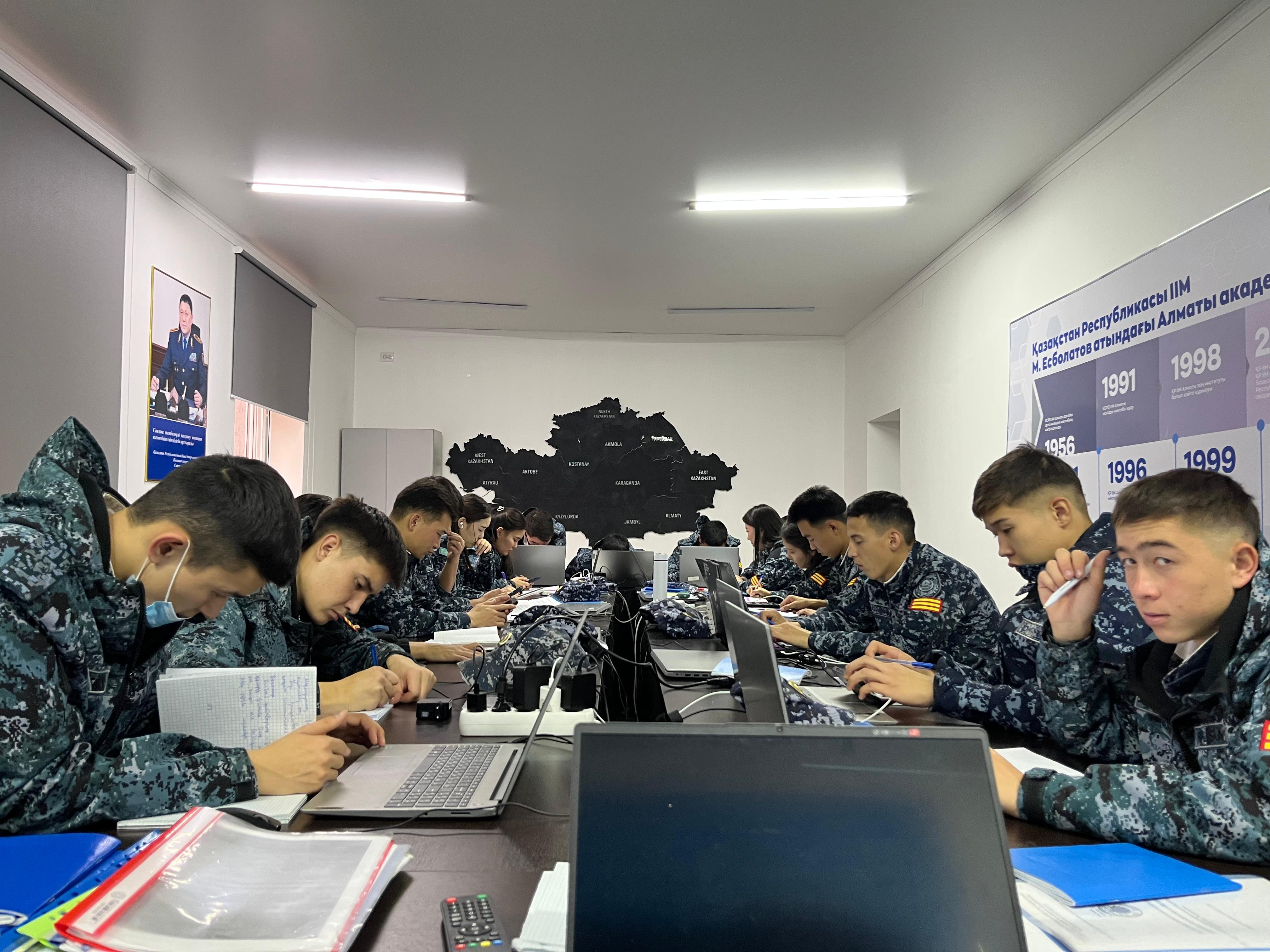
Cadets carry out practical projects on modeling cyber incidents, analyzing digital traces of crimes, developing response algorithms for computer attacks, and preparing recommendations for protecting information systems. Using modern digital data analysis tools, they examine digital footprints, investigate relationships between objects, and identify signs of fraudulent schemes. AI helps them systematize large amounts of information, uncover hidden patterns, and formulate analytical conclusions, which significantly enhances the efficiency of completing practical tasks.
– In what direction do you see the department's further development?
– One of the priority areas is the creation of an intelligent educational ecosystem that integrates digital training courses, an automated competency assessment system, virtual laboratories, cyber ranges, and decision support services.
Moreover, the implementation of an intelligent digital mentor could accompany a cadet throughout their entire period of study. Such an assistant would analyze learning outcomes, recommend additional materials and individual assignments, monitor the dynamics of competency development, and promptly identify topics requiring further study.
There are also plans to create a library of digital investigation scenarios for cybercrimes, based on modeling real methods of committing crimes in the digital environment. This would allow cadets to practice action algorithms for investigating various categories of cyber incidents, updating scenarios to reflect new criminal methods and modern countermeasures.
The department plans to further develop virtual and augmented reality technologies in combination with AI. Through this, each trainee will be able to make procedural decisions, interact with digital evidence, analyze network infrastructure, and receive objective real-time feedback on their actions.
Thus, the modern system of training personnel for internal affairs bodies is undergoing a deep digital transformation, and AI is becoming an important tool for improving the quality of education, developing professional competencies, and shaping a new generation of police officers.
The experience of the Department of Cybersecurity and Information Technologies at the Almaty Academy of the Ministry of Internal Affairs of the Republic of Kazakhstan confirms that the introduction of new technologies facilitates the transition from a traditional teaching model to a practice-oriented educational process based on modeling real operational situations, data analysis, and the use of modern digital technologies.
By implementing these processes within the framework of current legislation, adhering to the principles of academic integrity, information security, and professional ethics, AI can be made an effective tool for training highly qualified law enforcement officers capable of successfully performing their duties in the rapidly evolving digital society.
Interviewed by Ravil KASYMOV
Zanmedia.kz
Comments powered by CComment