

The Almaty City Court is working on the creation of a historical museum dedicated to the formation of justice in the city of Almaty.
The initiative belongs to the Chairman of the Almaty City Court, A.S. Zhukenov, and serves not merely as a tribute to the past but also as an important step toward reviving the pages of history and the stages of the consistent development of Kazakhstani justice.
Abay Zharylkassyn, Deputy Head of the Judicial Administration for Almaty City, talks about the organisational work currently being carried out.
– Abay Galymzhanovich, what archival and historical materials will form the museum's collection? And which documents and exhibits are of museum value?
– First of all, I would note that the decision to establish the museum was supported by the veteran community and the entire staff of the Almaty City Court, whose rich biography reflects the path traversed by Kazakhstan's judicial system. The museum represents continuity and respect for the past, which contains many different and interesting chapters – from handwritten verdicts to mechanical typewriters. It is important to preserve all these and other artefacts, immortalising the work of judges who made a significant contribution to the history of the courts of Almaty and the entire judicial system.
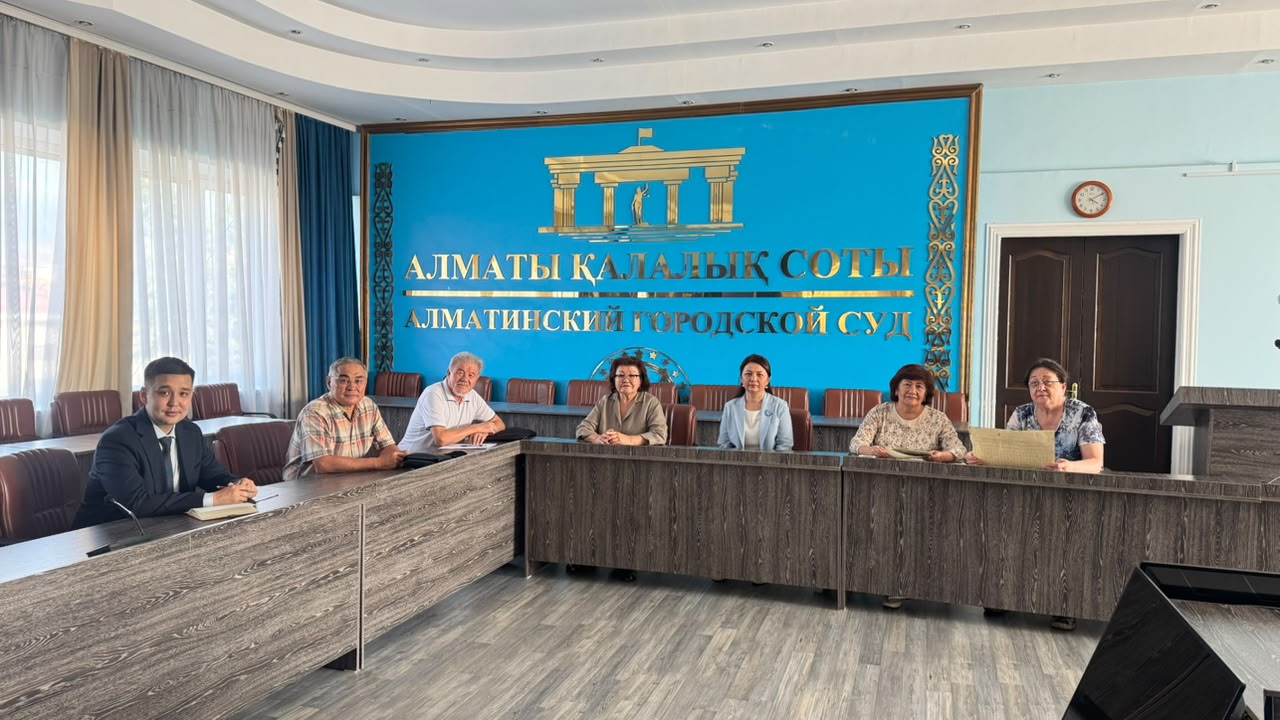
To recreate these pages, the Department of the Judicial Administration for Almaty is working to form the exposition of the future museum and its sections. A working group comprising judges and representatives of the veteran community is determining, at its meetings, the directions for searching for and collecting documents, photographs, and future exhibits. In more detail, these include biographical information and photographs: lists of judges of the Almaty City Court, as well as people's judges of the district courts of Alma-Ata and their predecessors; photographs of courthouses from past years, including the Almaty City Court at 25 Tulebaeva Street in 1969–1980, including group photos of judicial panels, official ceremonies, and congresses of judges.
A special place in the museum's exposition will be devoted to documentary records – decisions of executive committees and sessions of the city Council of People's Deputies on the election of people's judges and appointment of court chairpersons. These materials are necessary for creating the section "History of the Judicial System in Persons."
It is important to preserve materials on individual courts: historical information about the court – date of establishment and details of renamings; key stages of the court's development; significant historical events, as well as biographical information about court chairpersons, photographs and data about judges. Of particular interest are the records and reminiscences of frontline veterans, Afghan war veterans, home-front workers, and veterans of the judicial system, with biographical details, awards, photographs, and archival materials.
Also of museum value are archival materials: copies of orders, historical documents, publications, anniversary materials, copies of judicial acts on significant cases.
– You mentioned that the museum's sections will have room for exhibits. Which items are we talking about specifically?
– These are objects reflecting the work of the courts in previous periods: typewriters, judicial robes, identification cards, awards, archival equipment, nameplates, and other commemorative items that reflect history.
I should note that all materials already being added to the collections of the future museum are accepted in accordance with established procedures, following a corresponding checklist, with inspection and photographic documentation. Their preservation and intended use will be guaranteed. Items donated to the museum are planned to be used in its exposition as material evidence from various periods of the judicial system's activity.
For the new generation of judges, it will be interesting to see the items their colleagues used in bygone years. Take, for example, paper summonses for court parties, the camera used for interviews, samples of certificates, documents and materials about judicial system veterans, and their awards.
From photographs of those years, one can clearly see what the courts looked like in the past, and all those who laid the foundation of the judicial system, and feel the atmosphere.
– You noted that the museum will reflect the evolution of our state's judicial system. What period will this cover?
– Yes, the creation of the historical museum presupposes an excursion into the early periods of the development of justice on the territory of Kazakhstan, beginning with the traditional court of biys, the legal norms of the Kazakh Khanate, up to justice in the era of the imperial and Soviet systems. This was a long and difficult path towards the modern independent judicial system of our state.
Therefore, we consider it necessary to show the origins of statehood and the traditional judicial system in historical chronology, so that today's young people, students, beginning lawyers and judges know about the great pages, starting from the formation of the Kazakh Khanate in the 15th century, the khans and the steppe arbiters of justice – the biys, who laid the foundations of legal culture.
These pages, which have gone down in history as the "Golden Age of Justice," must be known. They must be valued, and we must take pride in the fact that it was on Kazakh soil that the unique institution of the biys was created – authoritative, respected members of society who performed judicial functions and possessed deep knowledge of customary law.
The museum should clearly demonstrate that an important part of the social structure of Kazakh society was precedent, which laid the foundation of the traditional system of dispute resolution. And it is our duty to highlight these stages, including the role of "Zhety Zhargy" – "Seven Ordinances," promulgated in 1684 and associated with the name of Khan Tauke. We can be proud of this legal code as an important source of traditional law that regulated social relations, property issues, family matters, military service, liability for offences, and the procedure for dispute resolution.
Also the period of the 18th–19th centuries, when significant political and administrative changes took place on the territory of Kazakhstan, and the system of governance and dispute resolution gradually transformed under the influence of the legislation of the Russian Empire. A time when traditional Kazakh customary law and the imperial judicial-administrative system interacted. And, of course, the Soviet period, associated with the formation of a new structure of state bodies and courts, when the country's judicial system developed within the framework of a unified judicial system of the USSR, and people's courts, regional and republican judicial bodies, the prosecutor's office and justice bodies were created.
The history of the judicial system of the independent state deserves separate and special attention, with the attainment of Independence by the Republic of Kazakhstan in 1991, which marked a new era in the development of the national judicial system.
The adoption of the Constitution of the Republic of Kazakhstan on 30 August 1995 must be regarded as a most important stage in its formation, laying the foundations of the state's modern legal system, establishing the independence of the judiciary and the basic principles of the administration of justice.
This gave impetus to the consistent transformation of judicial bodies, the creation of specialised courts, the introduction of modern forms of judicial proceedings, and the enhancement of transparency and accessibility of justice for citizens. All these pages of history deserve to be reflected in the museum's expositions.
Therefore, the initiative to create precisely a historical museum is something more than just collecting archival materials. For the current generation of judges, it is important to establish living threads to the past, showing continuity, the work of predecessors, and contemporary trends in justice – that the history of the court is, above all, the history of human destinies, the history of the city, and the transformations that have taken place in the country's judicial system.
Our generation bears the responsibility for preserving historical memory and the professional traditions of the judicial system. So that every document and exhibit finds a worthy place, bearing witness to the history of the judicial system, showing what the common path to modern achievements and the digital development of justice has been.
Taking this opportunity, I would like to express gratitude to everyone who not only responded but is also directly involved in its opening – our veterans, sitting judges, and court staff. We are confident that the photographs, documents, video materials, items of judicial insignia and materials from personal archives they have collected and donated to the museum's collection will make it possible to create a comprehensive historical picture reflecting the development of the judicial branch and its role in strengthening legality and the rule of law in Kazakhstan.
Work in this direction continues.
Interviewed by Asem SAKENOVA
Comments powered by CComment