

On June 12, 2026, Almaty hosted the International Scientific and Practical Conference titled "The Development of Administrative Justice in Light of the New Constitution: Guidelines for Law Enforcement and Legislative Initiatives," organized by the Almaty City Court and Narxoz University.
The large-scale event brought together leading legal scholars, judges, members of Parliament, representatives of international organizations, and civil society.
The conference was held in the format of three plenary sessions. The dialogue platform provided participants with the opportunity to discuss the impact of updated constitutional provisions on the further development of this field, current law enforcement challenges, and promising legislative initiatives aimed at improving administrative proceedings.
One of the key events of the conference was the signing of a Memorandum of Cooperation between the Almaty City Court and Narxoz University. The document was signed by Abai Zharylkasyn, Acting Head of the Department of the Judicial Administration of the Republic of Kazakhstan for the City of Almaty, and Kanat Kozhakhmet, President of Narxoz University.
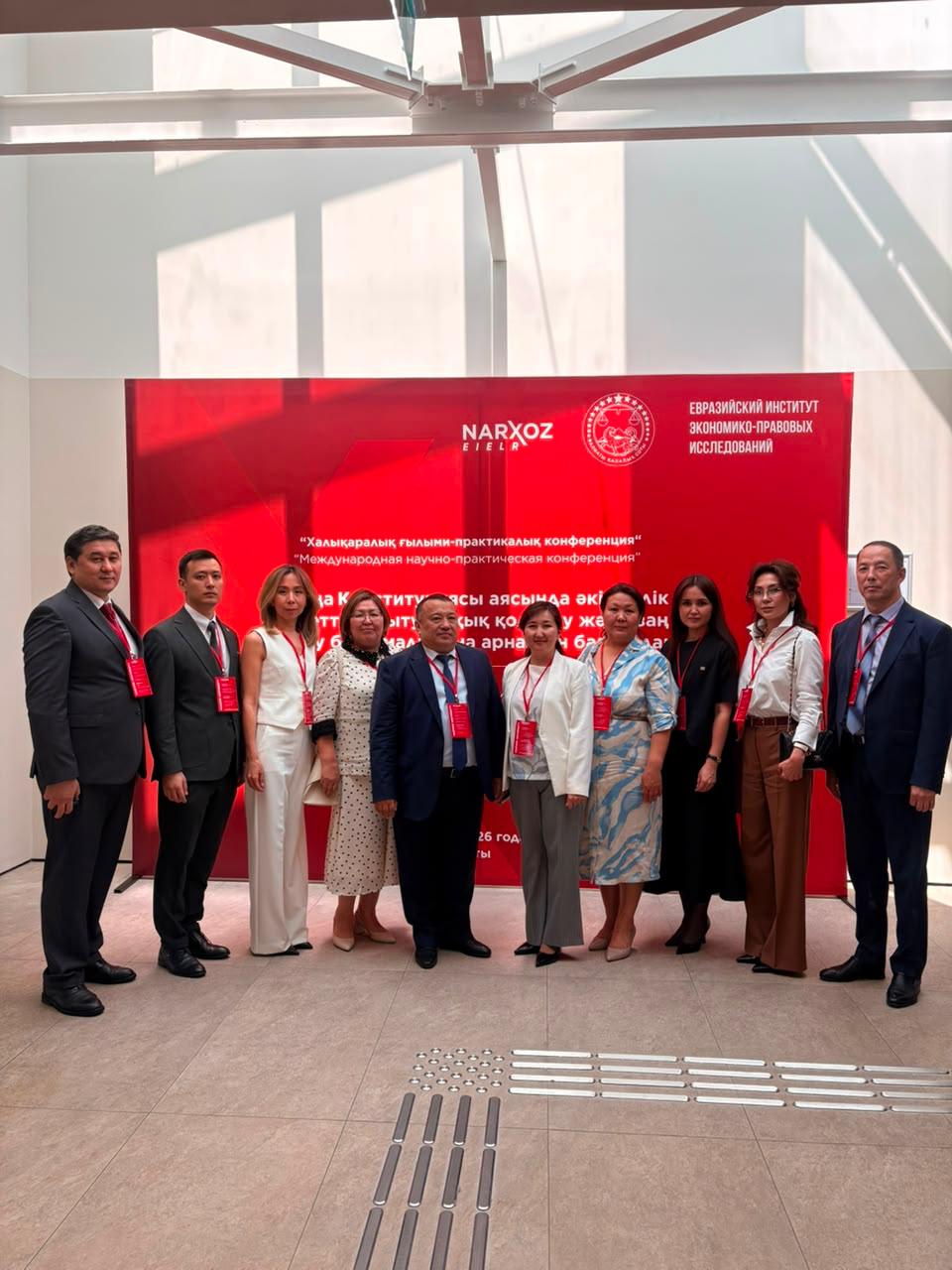
The agreement provides for cooperation in the following areas: research activities (joint studies, publications, conferences); internships for students in judicial bodies; implementation of joint educational projects involving judges; and professional development for court staff with the involvement of university faculty.
The parties emphasized that the Memorandum is aimed at bridging the gap between the theoretical training of future lawyers and the practical aspects of justice, as well as fostering the development of the professional community. The document lays the foundation for long-term partnership in training qualified legal personnel, conducting joint research, organizing internships, and creating expert platforms.
The arrangements enable regular exchange of experience between practicing judges and the academic community, which will contribute to the formation of consistent and stable practices in administrative cases.
– The administrative justice institute has proven its relevance. Today we see that its further evolution requires a synthesis of science and practice. The signed Memorandum serves as a bridge between theory and real-world justice, – noted the forum organizers.
During the discussions at the plenary sessions, it was emphasized that over five years, the administrative justice institute has become a genuine mechanism for protecting citizens' rights against unlawful actions by the state.
Administrative justice, operating at the initiative of President Kassym-Jomart Tokayev within the framework of the "Listening State" concept since July 1, 2021, has laid the groundwork for large-scale societal transformations and prompt responses to citizens' appeals. These principles are enshrined in the Administrative Procedural and Procedural Code.
Speaking at the forum "Administrative Justice and Its Role in Ensuring the Rule of Law," held on June 5, 2026, Kassym-Jomart Tokayev emphasized: "Judicial practice in administrative cases has become a kind of 'litmus test' for the work of the state apparatus; it reflects the growing level of public trust in justice."
The Head of State also noted the fundamentally important significance of enshrining administrative justice in the new Constitution as an independent form of legal proceedings. The updated Basic Law, which comes into force on July 1, 2026, opens a new chapter in the development of the rule-of-law state.
Assessing the reform as one of the most significant transformations in the field of judicial protection of citizens' and businesses' rights in disputes with the state, the conference speakers – including Chairman of the Almaty City Court A. Zhukenov, Chairman of the Judicial Collegium for Administrative Cases M. Baigelov, judges of the Specialized Interdistrict Court, as well as Kazakh and foreign experts – emphasized that the key outcome has been a tangible strengthening of guarantees for the protection of citizens' and legal entities' rights, facilitated by a shift in the logic of judicial proceedings. Courts now play an active role, with the burden of proving the legality of their actions placed on administrative bodies. Statistical data confirm the effectiveness of this approach: there is a steady increase in the proportion of cases ruled in favor of citizens and entrepreneurs.
During the conference, experts – including representatives of the Supreme Judicial Council, the Almaty City Akimat, the Prosecutor's Office, members of the Board of the Atameken National Chamber of Entrepreneurs, the Bar Association, judges from Germany, Azerbaijan, and Armenia, foreign and domestic scholars, international experts, and lawyers – discussed the transition from a reactive model of judicial appeals to strategic management of judicial risks. Future work will involve shifting public-law disputes into the realm of administrative justice and ensuring consistency and stability in administrative practice.
The high level of expert discussion and the exchange of experience underscored the profound practical significance of professional dialogue involving judges, lawyers, and the legal community, which will continue to promote best practices in administrative proceedings. The further development of administrative justice is becoming a crucial condition for strengthening the rule of law, enhancing investment attractiveness, and ensuring sustainable economic development in Kazakhstan.
The conference concluded with a resolution containing specific recommendations for harmonizing legislation and improving the efficiency of administrative courts in light of Kazakhstan's new Constitution.
Akmaral ABDULOVA
Comments powered by CComment