

Over five years, administrative justice has become one of the most important institutions of the rule of law in Kazakhstan. More than 150,000 administrative disputes considered, an increasing number of decisions in favor of citizens and businesses, the introduction of uniform administrative procedures, and strengthened guarantees for investors all testify to a profound transformation in the relationship between the state and society.
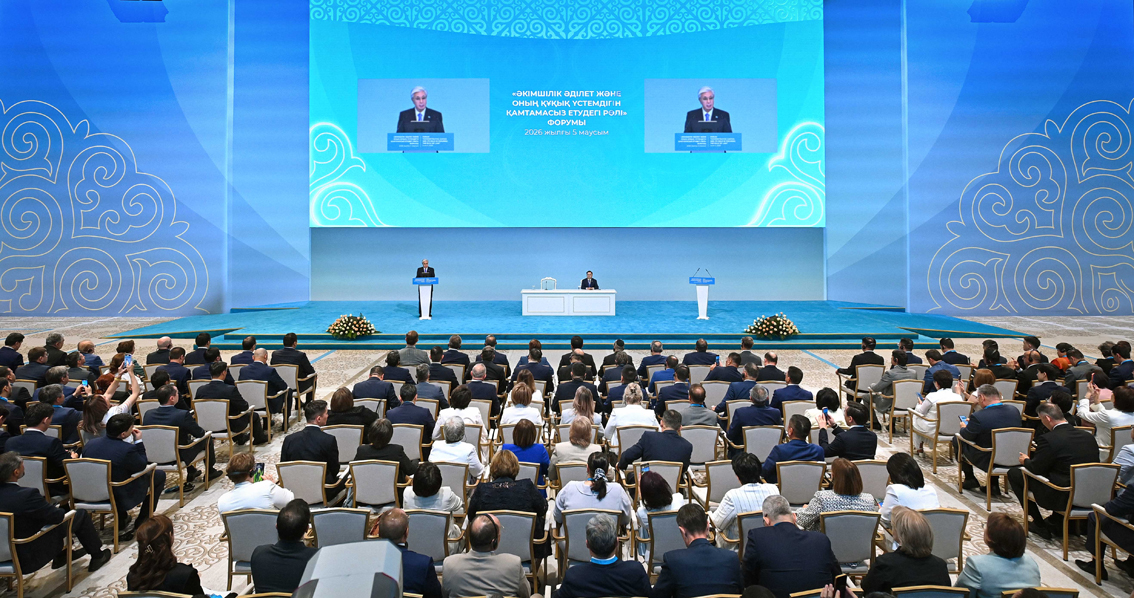
This was discussed during the international forum "Administrative Justice and Its Role in Ensuring the Rule of Law," which was attended by the President of the Republic of Kazakhstan, Kassym-Jomart Tokayev.
At the forum, leaders and judges of the Supreme Court, representatives of the Government, international organizations, major investors, and the business community discussed the outcomes of the functioning of administrative justice in Kazakhstan.
The Head of State provided a comprehensive assessment of the legal transformations being carried out in the country and outlined tasks for the further development of administrative justice. He emphasized the special significance of the agenda under discussion and noted that strengthening trust between society and the state is a fundamental condition for the country's successful development.
"Strengthening the integrity of the state and society is one of the main priorities in our activities. Undoubtedly, progressive development of the country is impossible without mutual agreement and trust between citizens and the authorities. But it is obvious that such agreement does not arise by itself. Public consent is the result of multifaceted, unceasing efforts," the President noted.
According to him, the concept of a "Listening State" is being consistently implemented, which provides for constant dialogue between the authorities and the population and prompt responses to the demands of society.
"We are putting into practice the concept of a 'Listening State.' The principles of open dialogue, taking into account the demands of society, and prompt response to citizens' appeals are the foundation of large-scale transformations. Representatives of all levels of government, including ministers, akims, and deputies, must take the most active part in this important work. This is the constitutional duty of civil servants," the Head of State said.
The President touched upon issues of legal culture and the need to foster a respectful attitude towards the law.
"In recent years, fundamental legal and social reforms have been implemented in the country. As a progressive nation, we must entrench the principle of 'Law and Order' as an integral feature of our national identity. It is necessary to explain in simple language to citizens, especially young people, the need for respect for the Law and law-abiding behavior. Observance of legality and order is an indispensable condition for ensuring a high quality of life for citizens," he noted.
The Head of State recalled that reforming the administrative justice system is part of the large-scale constitutional modernization of the country.
"This fundamental principle is clearly reflected in the New Constitution adopted at the national referendum. The Basic Law of Kazakhstan is the unshakable foundation of a Just Society, in which equal opportunities are ensured for all citizens. The highest value enshrined in our Constitution is the person and their inalienable right to life. The Constitution establishes such fundamental principles of state activity as respect for the rights and freedoms of citizens, ensuring the rule of law, and improving the well-being of the people," noted Kassym-Jomart Tokayev.
He emphasized that administrative justice has become one of the key elements of the new model of interaction between the state and society.
"As you know, in 2019 I announced the need to adopt a new model of administrative justice. This was a very important step taken to protect our citizens and entrepreneurs from illegal actions by authorities. In 2021, the Administrative Procedural Code came into force," the Head of State noted.
According to him, the digitalization of public services and the launch of the "e-Otinish" platform have played a significant role in developing feedback between the state and society.
"The launch of the online platform 'e-Otinish' gave a new impetus to the interaction between the state and society, becoming a tool for the most transparent and efficient consideration of citizens' appeals and for making prompt decisions. This system also provided ample opportunities to reduce red tape and take public opinion into account. Thus, a fundamentally new format of dialogue was formed between society and the state. The fact that over the past five years about 16 million appeals have been received by state bodies serves as convincing proof of this," the President emphasized.
Speaking about the changes in the judicial system that have occurred following the introduction of administrative justice, he noted that administrative proceedings have become an important indicator of the quality of work of state bodies.
"State bodies are required by law to prove the legality of their decisions and actions. According to statistics, in recent years more than half of court decisions have been made in the interests of citizens and businesses. Undoubtedly, this is a concrete result of the work of administrative justice. Thus, our society is beginning to get rid of the long-standing stereotype that judges always side with government officials," said Kassym-Jomart Tokayev.
The Head of State named the transition to the prevention of violations as one of the key tasks for the further development of the system.
"The consolidation of administrative justice in the new Constitution as an independent form of legal proceedings is of fundamental importance. On the agenda is a transition from a reactive model of judicial appeal to strategic management of judicial risks. The Government has already developed relevant rules. Now it is necessary to ensure uniformity of administrative acts and procedures at the central and local levels," he emphasized.
The President separately noted that judicial and law enforcement reforms are being implemented simultaneously with the large-scale economic transformation of the country.
"Currently, up to 80 percent of court decisions are made in favor of investors. During meetings with national and foreign investors, I insist that authorities and businesses should interact constructively, openly discuss current problems, and jointly seek ways to solve them. I instruct government officials in any controversial situation to seek compromises, but the search for a solution must not contradict the requirements of the legal system," Kassym-Jomart Tokayev set the task.
He focused on the activities of the court and the AIFC arbitration center, the work of the Investment Headquarters under the Government, and the creation of the Committee for the Protection of Investors' Rights under the Prosecutor General's Office.
"Currently, Kazakhstan is a regional leader in terms of attracting foreign investment. However, we cannot relax. We need to work diligently and strive for even higher goals. The potential of our country is quite sufficient for this," the Head of State instructed.
The Head of State also recalled the creation of a special legal regime for the city of Alatau.
"As is known, I recently signed the Constitutional Law 'On the Special Legal Regime of the City of Alatau.' This important document enshrines the legal framework for the formation of a 'smart city' ecosystem. The special legal regime provides for the expansion of public administration capabilities, including the special functioning of the judicial system. Progressive regulatory instruments will allow the implementation of best world practices, testing of advanced innovative solutions, and the creation of all necessary conditions for the implementation of this unique project. Our main goal is to transform the city of Alatau into a digital agglomeration of the future, a hub for new technologies," the President noted.
The practical results of the judicial reform were presented at the forum by Aslambek Mergaliyev, Chairman of the Supreme Court of the Republic of Kazakhstan.
He reported that in recent years, systemic changes have been implemented aimed at unifying judicial procedures and strengthening guarantees of fair justice.
According to him, in 2024, a new principle of uniformity of administrative procedures and administrative acts was enshrined in the APC (Administrative Procedural Code), obliging state bodies to make identical decisions in similar situations.
Furthermore, since 2025, extraterritorial jurisdiction has been introduced in the country.
"Unlike criminal and civil proceedings, the review of administrative cases in the Supreme Court was carried out under the principle of full cassation. This was necessary for the formation of proper law enforcement practice in all categories of public law disputes. As part of the unification of legal proceedings, the full cassation model has been implemented for the newly established independent cassation courts," noted Aslambek Mergaliyev.
The Chairman of the Supreme Court provided statistical data indicating the effectiveness of the reform.
"Over the past five years, more than 150,000 administrative claims have been filed with the courts. At the same time, the number of appeals is steadily increasing each year. This indicates that citizens and business representatives trust the new format of legal proceedings, viewing it as an effective mechanism for restoring violated rights. The growth in the share of cases won by citizens is particularly indicative: from 15 to almost 60 percent. Behind these figures lie the elimination of administrative barriers and the restored rights of specific people, entrepreneurs, and investors," he reported.
According to him, the Supreme Court annually analyzes judicial practice in investment disputes, which are most often related to taxation, customs regulation, environmental issues, and subsoil use. At the same time, a decrease in the number of such disputes has been recorded since 2024.
Regarding public trust, the head of the Supreme Court cited data from the Bureau of National Statistics, according to which the level of complete public trust in judicial bodies reached 63.2 percent, whereas in 2023 it was 55 percent.
During the subsequent panel session, participants moved on to assess the practical impact of the reform on the business environment and investment climate. Rustam Zhursunov, Chairman of the Board of the Association of Investors of Kazakhstan, noted that the introduction of the APC became one of the most successful legal reforms of the last decade, ensuring the implementation of principles such as the active role of the court, the presumption of the applicant's correctness, placing the burden of proof on the state body, as well as the principles of fairness, proportionality, and protection of the right to trust.
According to the Association, in 2024, entrepreneurs filed 8,453 administrative claims. The largest number of disputes are related to public procurement, tax issues, and land relations.
Results of an analysis of more than 665,000 appeals by legal entities in the e-Otinish system for 2025 were also presented. The largest number of appeals were received by the Ministry of Finance and the Government Office. The main issues concerned taxation, VAT, electronic invoices, public procurement, land relations, and registration procedures.
By Linara SAKTAGANOVA
Astana
Comments powered by CComment