

Having returned from China's spiritual capital – the ancient city of Xi'an – one cannot easily shake the feeling of having visited not just another country, but another dimension entirely.
RESPECT FOR HISTORY AS A DEVELOPMENT RESOURCE
The UNESCO-listed Eighth Wonder of the World – the Terracotta Army – the Great Wall of China, and its counterpart erected around the imperial palace grounds in Xi'an – these and other artifacts of an ancient civilization have not been relegated to the past or reduced to static museum exhibits. In China, antiquity is organically woven into everyday urban life, serving as a magnet for both domestic and international tourism.
This is the country's defining phenomenon, raising the question: what more can we, the heirs of the Great Silk Road, learn from our great neighbor, who has not preserved its history in amber? The Chinese have made it part of their brand, their economy, and their identity.
We, too, have much to be proud of. The mausoleums of Khoja Ahmed Yasawi and Arystan Baba, with their powerful and sacred energy; the Tamgaly petroglyphs; the ancient cities of Otrar and Sarayshyk; and other relics that we treat as protected monuments.
The Chinese, however, leverage their heritage as a source of national pride, having carefully integrated it into daily life and monetized global interest as a competitive advantage yielding billions. Perhaps we should adopt this approach as well: not merely restoring monuments, but actively promoting the narratives behind them, reflecting them in modern digital forms and creating 3D immersive experiences to transform them into true points of attraction.
Aware of their greatness, they do not nostalgically dwell on it – they use it as a springboard. Thus, the ancient Silk Road as a historical fact has become the brand behind the Belt and Road Initiative, where history is inseparable from economics, culture from politics, and the past from the future.
Kazakhstan, standing at the crossroads of civilizations, is part of the Great Silk Road. We too possess a unique history – from the Saka to Abai. Yet we often live as though these are two separate parallel tracks: one in textbooks, the other in reality. China teaches us that they are one continuum. We are equally capable of becoming a country that bridges Europe and Asia, past and future, tradition and innovation.
And the key lesson here is quite simple: greatness is not inherited. It is built every day – through immense effort, patience, self-respect, and reverence for one's roots.
We live in a young nation grown from ancient roots. We have everything we need to become a great nation, to build our future – just as they do – with our own hands, our own minds, and our own hearts.
ECONOMIC CLUSTER
They say that to understand China, one must see two cities: the ultra-modern Shanghai, reaching for the sky, and Beijing, which preserves the memory of bygone empires. There is a third city, known as the heart of China – Xi'an – where, standing at the foot of a fortress wall older than most nations on Earth, you witness the interweaving of centuries.
China's economic development here feels like a pulse. And while the country is often perceived as an endless factory, Xi'an is more of a giant construction set. Pagodas illuminated at night with LED lights have become the precursor to a powerful economic cluster: tourism, IT development, and logistics. The economy has made history its driving force. If two thousand years ago caravans laden with silk passed through here, today freight trains carrying solar panels and smartphones roll along the same routes.
The nation's high level of organization has allowed it to transform antiquity into a premium environment – through state investment and meticulous, pragmatic restoration – making it a hub for startups and creative industries. This city serves as a window into China's economic miracle. It did not happen in a vacuum; it has been consciously built on diligence, wisdom, and large-scale thinking. On this path, a great history gives its people wings to soar, making the nation strong and prosperous.
UNITY IN DIVERSITY
China is overwhelming in its scale and population – this much is evident. Dozens of ethnic groups, hundreds of dialects. Yet everything is perceived as a cohesive whole: the Muslim quarter with its mosques and hand-pulled noodles coexists alongside Buddhist pagodas and Taoist temples. A national identity has been forged without erasing local characteristics or enforcing uniformity. Unity here rests on deep foundations – economic projects, shared culture, and common history. When a resident of Ürümqi feels as connected to the Qin Empire as a resident of Shanghai, that cohesion works more powerfully than any administrative measure or slogan.
LABOR AND DISCIPLINE AS NATIONAL VALUES
Morning in Xi'an reveals how early life begins here. The streets are already full by six in the morning: elderly people practicing tai chi in parks, shopkeepers opening their stalls, students with backpacks rushing to classes. In China, one sees no signs of idleness. Labor is not a dreary obligation or a burden, but a means of self-realization – a natural rhythm of life in which everyone knows their place and their task.
The economic miracle of the Middle Kingdom was built not on natural resources (of which China has relatively little per capita), but on human capital. Instead of relying on oil and gas as we do, their greatest wealth lies in their people, who form the solid foundation of their country. They understand well that there is no such thing as "easy money" – creative labor, elevated to the status of a virtue, is far more reliable.
INFRASTRUCTURE AS PHILOSOPHY
China's roads, railway stations, airports, subway stations, and residential skyscraper districts impress with both functionality and aesthetics. Scooters and mopeds of various configurations, bicycles – and no electric kick-scooters in sight. Traffic, even on narrow streets, is quiet, without the nervous honking we are accustomed to. In all other respects as well – discipline, punctuality, and responsibility prevail.
Overall, it is evident that everything here is designed with a margin of safety and with future growth in mind. Our great neighbor demonstrates systematic thinking and an obsession with quality and detail: every project is part of a larger strategy of monumental scale. In China, they do not build merely to submit a progress report – they build to leave a mark for centuries. In contrast, our infrastructure projects often suffer from underfunding, short-sighted decisions, or corruption.
Technology here has permeated daily life, education, healthcare, and governance – and it works seamlessly. China does not need to catch up with the world in digitalization; it sets the trends, showing that technology does not merely simplify life – it reshapes mindsets, creating a new philosophy of interaction between the individual and the state, rather than merely replacing paper with screens and digitizing old processes.
THE IMMORTAL GUARDIANS OF ETERNITY
I wish to conclude my observations by returning to history – the main brand of Xi'an and of all China: the Terracotta Army. To reach the site, one must navigate an endless stream of visitors. After passing through digital checkpoints and security checks, we enter a vast semi-dark hall where thousands of silent, life-sized terracotta figures of soldiers, horses, and chariots seem to rise from the earth, standing in their underground corridors. They appear ready to repel any threat that might disturb the peace of their emperor. The sight takes one's breath away.
Since 1987, the Mausoleum of Emperor Qin Shi Huang and his Terracotta Army have been officially inscribed on the UNESCO World Heritage List. For its incredible scale, historical value, and uniqueness, it has also been accorded the status of the "Eighth Wonder of the World." According to historical records, the army was created more than 2,200 years ago by order of China's first emperor, Qin Shi Huang. It was discovered in 1974 entirely by chance by peasants digging a well. The army was subsequently recognized as one of the greatest archaeological finds of the 20th century.
Since then, archaeologists have excavated three main burial pits, containing about 8,000 terracotta figures of soldiers and horses, over 100 chariots, and more than 40,000 pieces of bronze weaponry.
Historians assert that Emperor Qin Shi Huang, who unified China in 221 BC, was obsessed with the idea of immortality, leaving behind not merely a tomb but an entire underground realm in which he intended to rule even after death. According to various estimates, up to 700,000 workers labored on this burial complex for nearly 40 years.
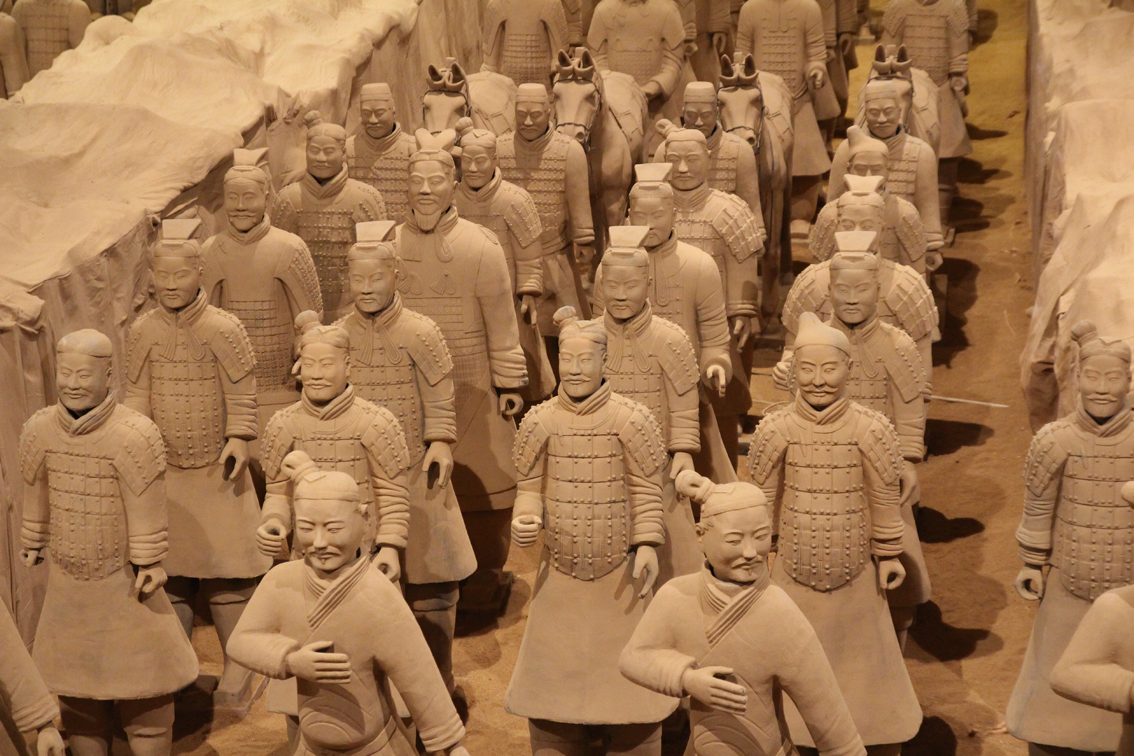
The uniqueness of the Terracotta Army lies not only in its scale but also in the extraordinary craftsmanship of the ancient artisans – each warrior has distinct facial features: no two hairstyles are alike, reflecting the ethnic diversity of the Qin Empire. Archaeologists identify at least eight different head forms, all with manually carved, individualized features.
The statues also vary in height, ranging from 1.8 to nearly 2 meters. Generals are noticeably taller than ordinary soldiers. Even the footwear of each figure is rendered with exquisite precision, including woven patterns on the soles. The vivid colors have faded over time, but thanks to modern technology and collaboration with, for example, German specialists, traces of pigment are being preserved on newly uncovered figures.
The weaponry discovered alongside them is equally astonishing in its state of preservation and complexity of manufacture. Thanks to the Terracotta Army, historians have a unique window into the military organization of ancient China, including troop formations, types of weapons, armor, and tactics. The warriors are arranged in distinct units: archers stand at the front, followed by chariots with officers, then heavy infantry – a carefully planned battle formation that reflects the military thinking of the time.
The army was produced in several small workshops, where artisans used different clay recipes for different parts and stamped their seals on the figures for quality control – a precision machine of the Chinese empire that has been inherited by today's administrators.
The Terracotta Army holds one more secret: it was never meant to be seen by the living. And so it is that today, among millions of tourists, we intrude upon a space created for eternity, not for a museum.
A monument to human vanity, it has become a tribute to the nameless masters who poured their souls into each clay figure. The might of China's first unifier reminds us that even the greatest empires are not immune to time.
Thus, the significance of the Terracotta Army in world history extends far beyond that of a museum exhibit or an archaeological find. This Wonder of the World transforms our understanding of time, power, and human genius, embodying the very essence of the state itself: its formidable potential, its skilled governance, its focus on growth drivers – from leveraging history and human capital to uniting a great nation around a common purpose and providing incentives for labor, offering a chance not merely to survive but to thrive and prosper.
And it is precisely this that has yielded phenomenal results, propelling China to the forefront of global rankings.
Akmaral ABDULOVA
Comments powered by CComment